Choosing your fund administration model
Written By

Written By
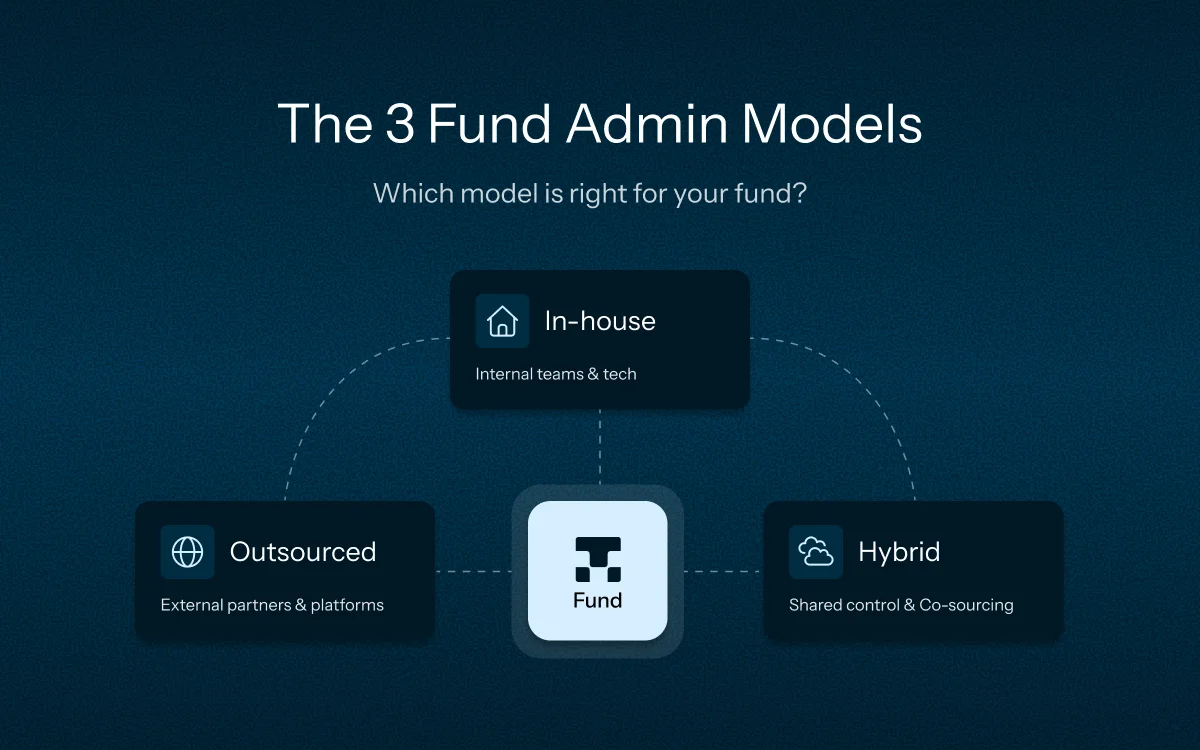
Every unlisted fund manager must decide how to run daily funds management operations. There are three models: in-house using purpose-built software, outsourcing to a third-party administrator, or a hybrid of the two. The right choice depends on how much control you want over investor data, how you want investors to experience your brand, and how complex your funds are.
The decision goes beyond who processes applications and distributions. It shapes operational scalability, investor trust, and data ownership and sovereignty.
Outsourcing has long been the standard response to growing pains or headcount pressure. Purpose-built funds management software has since given managers considerably more control than they once had. The three options are set out below.
In-house administration once meant several team members maintaining Excel spreadsheets across different funds. The modern version runs on software designed for funds administration and registry operations. It brings built-in user controls, audit trails, operational efficiencies, branded investor portals and digital investor onboarding.
Under this model, a third-party administrator takes over the daily work: investor applications, distributions, transactions, reporting and other registry functions. This can save time and, by reducing headcount, may lower costs. It also frees your team to concentrate on growing the business.
The hybrid model is the most recent of the three and combines in-house and outsourced administration. A manager might keep flagship funds in-house to offer investors a high-touch experience, while outsourcing legacy or highly complex funds to a third-party administrator.
| Feature | In House (with Unitise) | Outsourced | Hybrid |
|---|---|---|---|
| Investor Experience | Elite & branded | Standard | Mixed |
| Data and operational control | Full ownership & control | Low – Admin usually controls this | Segmented; data in different systems |
| Speed to action | Instant and highly reactive | Medium to delayed | Variable |
The right model changes as your business does, and different stages of growth favour different approaches. The traditional reason to outsource was to cut headcount or fix time-consuming processes. With a platform like Unitise, a small team can handle every aspect of funds management operations.
Investor expectations are also moving towards real-time transparency, which tends to favour managers who invest in their own technology. An in-house software model builds scalable infrastructure for fund operations and investor relationships, and keeps data ownership and integrity with you.
Book a free demo and see how our funds management, investor portal and digital investor onboarding software could support your in-house operations.